
Cūḷaka-Seṭṭhi Jātaka
Cūḷaka-Seṭṭhi Jātaka
In the ancient city of Mithila, a bustling hub of trade and commerce, lived a wealthy merchant named Cūḷaka. He was known throughout the land not only for his vast riches but also for his immense generosity. Cūḷaka believed that wealth was a tool to alleviate suffering and uplift those less fortunate. The Bodhisatta, in this life, was born as Cūḷaka the merchant.
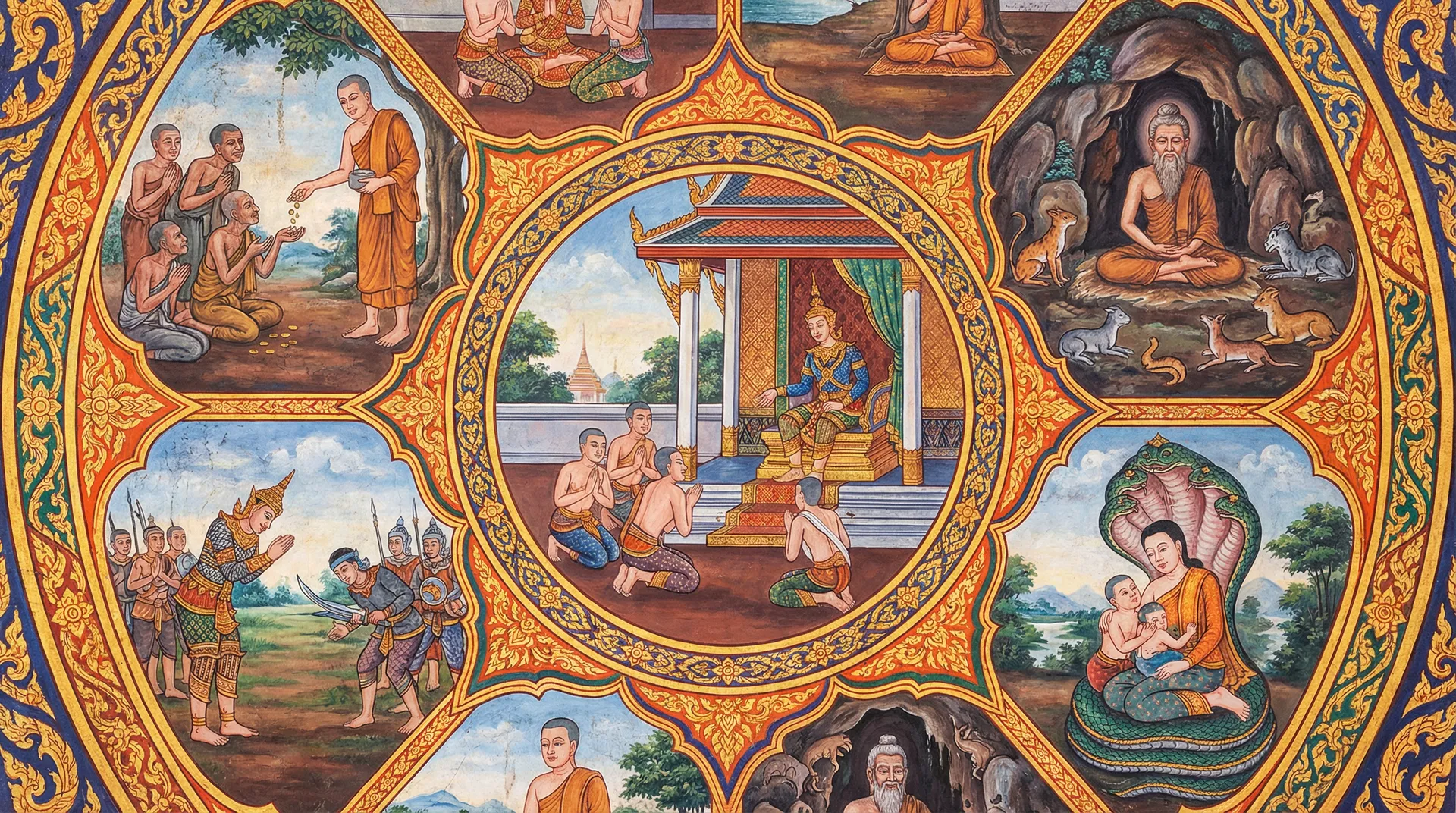
Cūḷaka's generosity was legendary. He funded orphanages, built hospitals, provided food and shelter for the poor, and supported countless individuals in their endeavors. His mansion was always open, and his table was always set for anyone in need. He lived a life of constant giving, finding his greatest joy in the happiness of others.
However, Cūḷaka's unparalleled generosity also attracted a different kind of attention. A neighboring king, a man consumed by avarice and a desire for Cūḷaka’s wealth, began to plot. He saw Cūḷaka’s open-handedness not as virtue, but as foolishness. He devised a scheme to seize Cūḷaka’s fortune and add it to his own coffers.
The king sent his spies to observe Cūḷaka. They reported back on the merchant's daily activities: his donations, his charities, and his seemingly boundless spending. The king, misinterpreting Cūḷaka's actions as a lack of foresight and a sign of impending bankruptcy, decided to make his move.
One day, the king, disguised as a humble traveler, arrived at Cūḷaka’s doorstep. "Noble merchant," he said, his voice laced with false humility, "I have heard tales of your great charity. I am a poor traveler, robbed of all I possess. I beg you for a small sum to help me return to my home."
Cūḷaka, his heart always open to those in need, welcomed the 'traveler' in. He offered him food, clothing, and a comfortable place to rest. When the traveler spoke of his plight, Cūḷaka did not hesitate. He summoned his treasurer and instructed him to give the traveler a substantial amount of gold – enough to live comfortably for many years.
The king, stunned by the sheer magnitude of the gift, could barely conceal his astonishment. He had expected a few coins, perhaps, but this was a fortune. He thanked Cūḷaka profusely, his mind already racing with plans to return with his army and claim the rest.
After the king left, Cūḷaka's treasurer, a man known for his prudence, approached his master with concern. "Sir," he said, "the traveler you aided was indeed the King of the neighboring land. While your generosity is commendable, giving away such a vast sum to a single person, especially one who may be deceitful, is a risk. What if he uses this gold to fund an attack against us?"
Cūḷaka smiled gently. "My dear treasurer," he replied, "wealth is like a river. If it flows only in one direction, it stagnates. It must be allowed to flow outwards, to nourish and sustain. If the king uses this gold for ill, then his karma will reflect that. But if he uses it for good, or if this act of giving inspires him to be more generous himself, then we have both served a greater purpose."
True to his word, the king returned not as a traveler, but with his soldiers. They surrounded Cūḷaka's mansion, demanding that he surrender all his wealth. The king, emboldened by the immense sum he had already received, declared, "Merchant Cūḷaka, your generosity has blinded you! You have given away your fortune foolishly. Now, I shall take what remains for the good of my kingdom!"
Cūḷaka, however, remained unfazed. He stepped out to face the king and his soldiers, not with fear, but with a serene dignity. "Your Majesty," he said, his voice calm and clear, "you have taken a portion of my wealth, and I did not resist, for I believe in the flow of giving. But you mistake the nature of true wealth."
He then gestured to his mansion, his gardens, and the people who were now gathering, drawn by the commotion. "This is my true wealth," Cūḷaka declared. "The love and respect of my people. The gratitude of those I have helped. The peace of mind that comes from a life of giving. These are riches that cannot be plundered by any army."
As the king looked around, he saw the faces of the townspeople – the orphans Cūḷaka had raised, the sick he had healed, the families he had supported. They stood protectively around Cūḷaka, their faces filled with admiration and loyalty. They were ready to defend their benefactor with their lives.
The king, witnessing this profound display of love and community, was humbled. He saw that Cūḷaka’s wealth was not in gold and jewels, but in the bonds of compassion and goodwill he had cultivated. He realized that his own greed had made him poor, while Cūḷaka's generosity had made him truly rich.
Ashamed, the king lowered his sword. "Cūḷaka," he admitted, his voice heavy with remorse, "I have been a fool. I sought to plunder your riches, but instead, I have witnessed the true meaning of wealth. Forgive my greed. I wish to learn from you."
Cūḷaka, with his characteristic compassion, forgave the king. He invited the king to share in his meals and to learn about the principles of righteous giving. The king, humbled and transformed, abandoned his avarice and returned to his kingdom, vowing to rule with greater justice and compassion.
From that day on, Cūḷaka continued his life of boundless generosity, his wealth only growing through the goodwill and prosperity that flowed from his selfless actions. His story became a timeless reminder that true wealth lies not in what we hoard, but in what we give away, and that the greatest riches are found in compassion, love, and the well-being of others.
— In-Article Ad —
💡Moral of the Story
True wealth is not measured by possessions, but by the generosity of spirit and the goodwill cultivated through acts of kindness. Giving with a pure heart brings greater abundance.
Perfection: Generosity (Dana)
— Ad Space (728x90) —
More Jataka Tales You May Enjoy
 363Pañcakanipāta
Kaccābu Jātaka
Kaccābu JātakaIn the ancient kingdom of Mithila, ruled by a benevolent king, there lived a Bodhisatt...
💡 Physical ailments are often a reflection of inner mental and emotional imbalances. Cultivating a calm, compassionate, and virtuous mind is essential for true healing and well-being, as it addresses the root causes of suffering rather than just its symptoms.
 271Tikanipāta
Nimi Jataka
Nimi JatakaLong ago, in the ancient city of Mithila, ruled a wise and just king named Nimi. His reig...
💡 True fulfillment is found not in escaping worldly duties for heavenly pleasures, but in embracing one's responsibilities with virtue and compassion, thereby continuing spiritual growth amidst life's challenges.
129EkanipātaMora Jataka
Mora JatakaIn the heart of a dense and ancient forest, where sunlight struggled to pierce the thick ...
💡 True power lies not in physical strength or material possessions, but in the purity of virtue, the wisdom of compassion, and the ability to inspire transformation through truth.
76EkanipātaThe Tale of the Fragrant Tree
The Tale of the Fragrant Tree In the heart of a vast and ancient forest, where sunlight dappled thr...
💡 Curiosity, coupled with the courage to learn new things, can lead to great discoveries that benefit society.
137EkanipātaMaha-Ummagga Jataka
The Great Wisdom of Prince VessantaraIn the ancient kingdom of Kalinga, famed for its glittering cit...
💡 The highest form of generosity is to give even that which is most precious, understanding that true happiness lies in selfless giving and compassion for all beings.
44EkanipātaThe Bodhisatta as the Elephant King
The Bodhisatta as the Elephant KingIn the heart of a magnificent, ancient forest, where trees touche...
💡 True leadership is demonstrated through selfless sacrifice and unwavering dedication to the welfare of others.
— Multiplex Ad —